
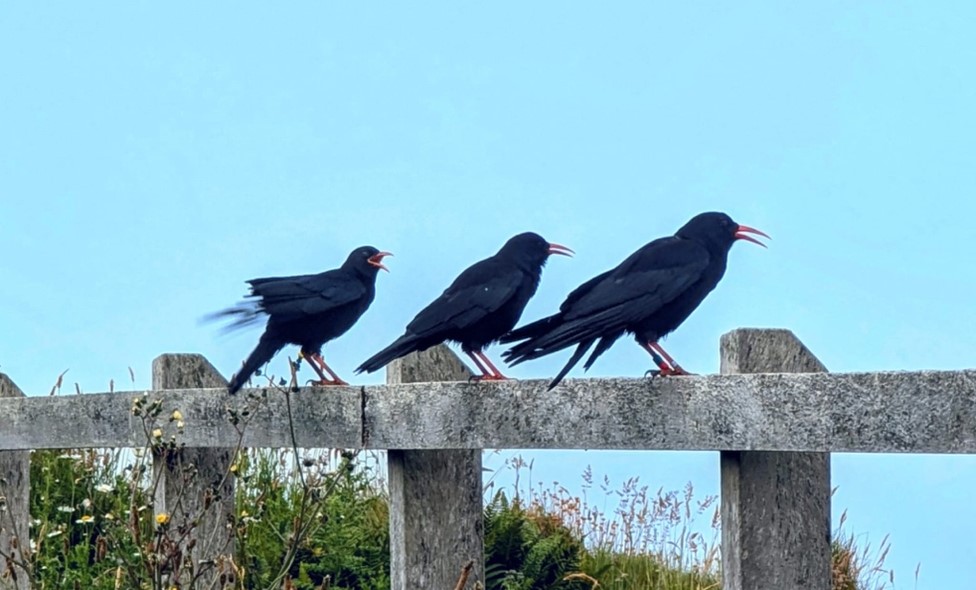
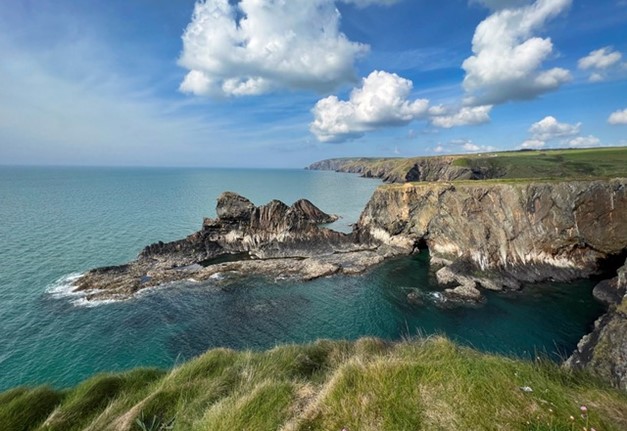
By Gill Lewis, Dagmarr Moore and supported by other concerned residents of Moylgrove and Ceibwr. Chough image by Steve Halton.
One year on: looking back and looking ahead
It’s been almost a year since the Wild Justice Judicial Review successfully challenged plans for an adventure hub at Ceibwr Bay in North Pembrokeshire, a proposal that brought wider concerns about the impact of commercial activity on this sensitive coastline. We reflect on what has changed, what has been achieved, and what we hope to see next. The changes that have followed have implications far beyond Ceibwr, with potential consequences for protected sites across Wales and the wider UK.
Important progress has been made, particularly around environmental assessment and how commercial coasteering is considered in protected areas. However, it is still too early to know whether these changes will provide the protection Ceibwr’s wildlife needs.
Why Ceibwr mattered
The Wild Justice legal challenge was never just about one bay or one proposed adventure hub. It was about protecting a coastline of exceptional wildlife value, home to nesting seabirds, grey seals and a rich diversity of marine and coastal life, recognised through its SSSI and SAC designations.
With support from the Environmental Law Foundation, concerns were raised about whether the required Habitat Regulations Assessment had been properly considered. Wild Justice recognised the wider importance of the issue, believing there were serious concerns about whether the assessment had been carried out lawfully and helped turn a local campaign into a legal challenge with implications far beyond Ceibwr.
The Judicial Review
Planning for the hub was granted in October 2024. The Judicial Review was heard in June 2025, and in September 2025 the High Court ruled in Wild Justice’s favour. The Court held that Pembrokeshire Coast National Park Authority’s decision to grant planning permission for the Moylgrove Adventure Hub was unlawful and quashed the permission.
The judgment highlighted the importance of decision-makers having access to the right ecological information before making decisions affecting protected sites. It also found that impacts on the Site of Special Scientific Interest, including potential impacts on Chough, had not been properly addressed.
A case that changed the conversation
Coastal recreation and adventure tourism are growing across Wales and the wider UK, bringing more people to some of our most spectacular and remote landscapes. But these same coastlines are also home to vulnerable and protected wildlife.
The Ceibwr case reinforced a key principle: the protection of wildlife and protected habitats must come first when considering activities that may affect these areas. The judicial review highlighted the importance of ensuring that decisions are informed by ecological evidence and a proper understanding of the sensitivities of each location.
Much of the Pembrokeshire coastline is designated as a Special Area of Conservation (SAC), and many stretches are also protected as Sites of Special Scientific Interest (SSSIs). Every part of this coastline is unique, supporting different habitats, species and ecological features. Some areas may be able to accommodate certain activities, while others may require a higher level of protection due to the wildlife they support.
What has changed since the Judicial Review?
The case has contributed to a wider discussion about how activities that may affect protected coastal areas should be considered.
1.Environmental assessment must come first
Where proposals or activities may affect protected sites, the environmental assessments required by law must be properly considered and supported by appropriate ecological evidence.
The Ceibwr judgment demonstrated the importance of ensuring that decision-makers have the relevant information before reaching a decision.
2.Licensing is being introduced
A licensing scheme for commercial coasteering on land owned or leased by Pembrokeshire Coast National Park Authority and the National Trust is now being developed.
It has the potential to provide a clearer framework for monitoring, operator responsibilities and enforcement.
However, its effectiveness will ultimately depend on how the scheme operates in practice.
3.Commercial coasteering sites must now be assessed individually
Each proposed commercial coasteering site in Pembrokeshire will now require ecological assessment, recognising that every location has different sensitivities and wildlife needs. Not every coastline is suitable for the same level of activity.
Ceibwr still matters
While the implications of the case reach much further, Ceibwr remains at the heart of this story.
We are still waiting to hear whether or not Ceibwr will be excluded from the list of approved commercial coasteering sites.
Ceibwr is a uniquely sensitive place, with seasonal breeding seabirds and grey seals, and rare resident wildlife. Our position remains clear: Ceibwr should not be included as a coasteering site.
Over a hundred local residents signed a letter to the National Trust to request that commercial adventure tourism must cease and that Ceibwr Bay’s ability to recover must come before continued commercial pressure.
Protection only works if rules are followed
New systems for assessment and licensing will only be effective if they are properly implemented, monitored and enforced.
Following an NRW breeding bird survey in 2024, a seasonal exclusion zone around nesting sites was subsequently advised in the Ceibwr 2025 coasteering site guide.
Concerns have subsequently been raised on many occasions that commercial activity has continued within areas identified as exclusion zones – increasing the risk to disturbance of nesting birds.
Until the new licensing arrangements come into force, the Coasteering Concordat remains the framework through which commercial coasteering providers have agreed to operate responsibly along the Pembrokeshire coastline. The Concordat is intended to provide confidence that commercial coasteering is carried out responsibly, with measures to protect sensitive wildlife and minimise disturbance.
We understand that at least one commercial provider has not signed the 2025 or 2026 Coasteering Concordat but continues to access the coastline.
In May 2026, the National Trust served a trespass notice on a commercial provider in relation to the commercial use of land at Ceibwr.
Residents have supported the National Trust’s decision.
Despite trespass notice, coasteering has continued at Ceibwr.
The lesson we draw from Ceibwr is that protected sites are only effectively protected when the measures intended to safeguard them can be implemented and enforced in practice.
We recognise that the licensing work being undertaken by Pembrokeshire Coast National Park Authority, alongside measures taken by the National Trust, is intended to address some of these concerns. However, only time will show whether these measures provide the meaningful protection that sensitive sites such as Ceibwr need.
In our view, effective conservation requires more than voluntary measures. It requires clear rules, effective monitoring and meaningful enforcement.
A change that reaches far beyond Ceibwr
The Ceibwr case began with a community standing up for a special place. With Wild Justice’s support, that local campaign became a legal challenge that highlighted the importance of proper environmental decision-making and stronger protection for sensitive coastal habitats.
The changes that have followed have the potential to influence how commercial coasteering and adventure tourism are managed across Wales and the wider UK. But the real test is whether those changes translate into meaningful protection.
For Ceibwr, the community is still waiting to see what the future holds. We hope that the lessons from this case will be learned, and that this exceptional place will be given the protection, space and time it needs to recover.
Our community campaign has been shortlisted for the Marsh National Park Nature Award, as part of the Campaign for National Parks’ National Park Protector Awards, which recognises the contribution of a group or campaign that has put nature at the heart of their work. The winners will be announced at the National Park Protector Awards ceremony in Westminster on 14 October 2026.
We have developed and delivered our own community blueprint for the recovery of Ceibwr Bay to Pembrokeshire Coast National Park Authority, Natural Resources Wales and the National Trust, and hope they will embrace it as a positive way forward for protecting and restoring this exceptional place.
This is one bay, but the concerns raised here have implications far beyond Ceibwr. This is one community, strengthened by the support of many, showing what can be achieved when people come together to protect a place they care deeply about. People who live alongside protected landscapes do not simply observe change from a distance; they experience it. They are often the eyes and ears of these places, seeing pressures and changes first-hand. Our knowledge, experience and concerns matter, and should be part of ensuring that protection on paper becomes meaningful protection on the ground.
This way, we can ensure that Ceibwr and other sites of high ecological sensitivity and importance are protected for future generations, for everyone, forever.